The 4Cs Framework in Action
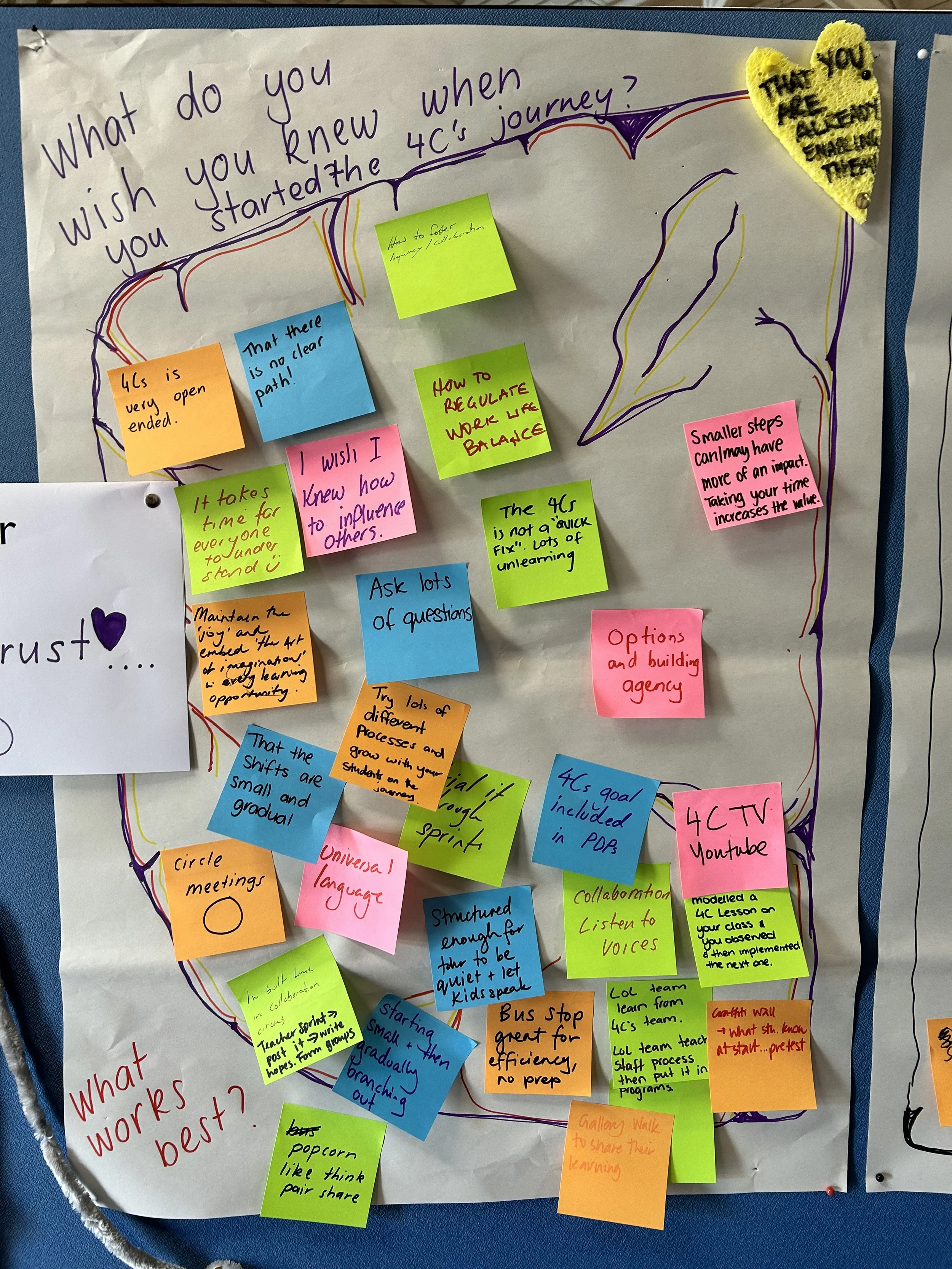
The strength of the 4Cs framework in educational contexts lies in its practical application. Michael Anderson and Miranda Jefferson, in their books Transforming Schools, Transforming Education, and Leading for School Transformation, emphasise that school transformation must occur at multiple levels:
1. Pedagogy (Teaching Practice)
Teachers design learning experiences that explicitly develop the 4C's. This includes:
Open-ended tasks
Project-based learning
Reflective discussions
Collaborative problem-solving
Importantly, the 4Cs are made visible and explicit, so students understand the capabilities are developing.
2. Curriculum Design
Rather than focusing solely on content coverage, curriculum in a 4C school is:
Concept-driven
Interdisciplinary
Connected to real-world contexts
This allows students to apply knowledge meaningfully while developing the 4C’s core capabilities.
3. Assessment
Traditional assessment often measures what students know. In contrast, the 4Cs assessment emphasises:
Process over product
Reflection over recall
Growth over grades
Students may be assessed on how effectively they collaborate, think critically, engage creative thinking or problem solving, or communicate ideas—not just on correct answers.
4. Leadership and Culture
Perhaps most importantly, the 4Cs framework extends beyond classrooms to shape whole-school culture.
School leaders play a critical role in:
Creating a shared vision
Supporting teacher innovation
Building trust and collaboration among staff
Transformation, as Anderson and Jefferson argue, is not about small improvements—it requires rethinking the entire system of schooling.